ICE Thinks They Can Rewrite the Constitution, But There's a Problem
Humor me for a moment.
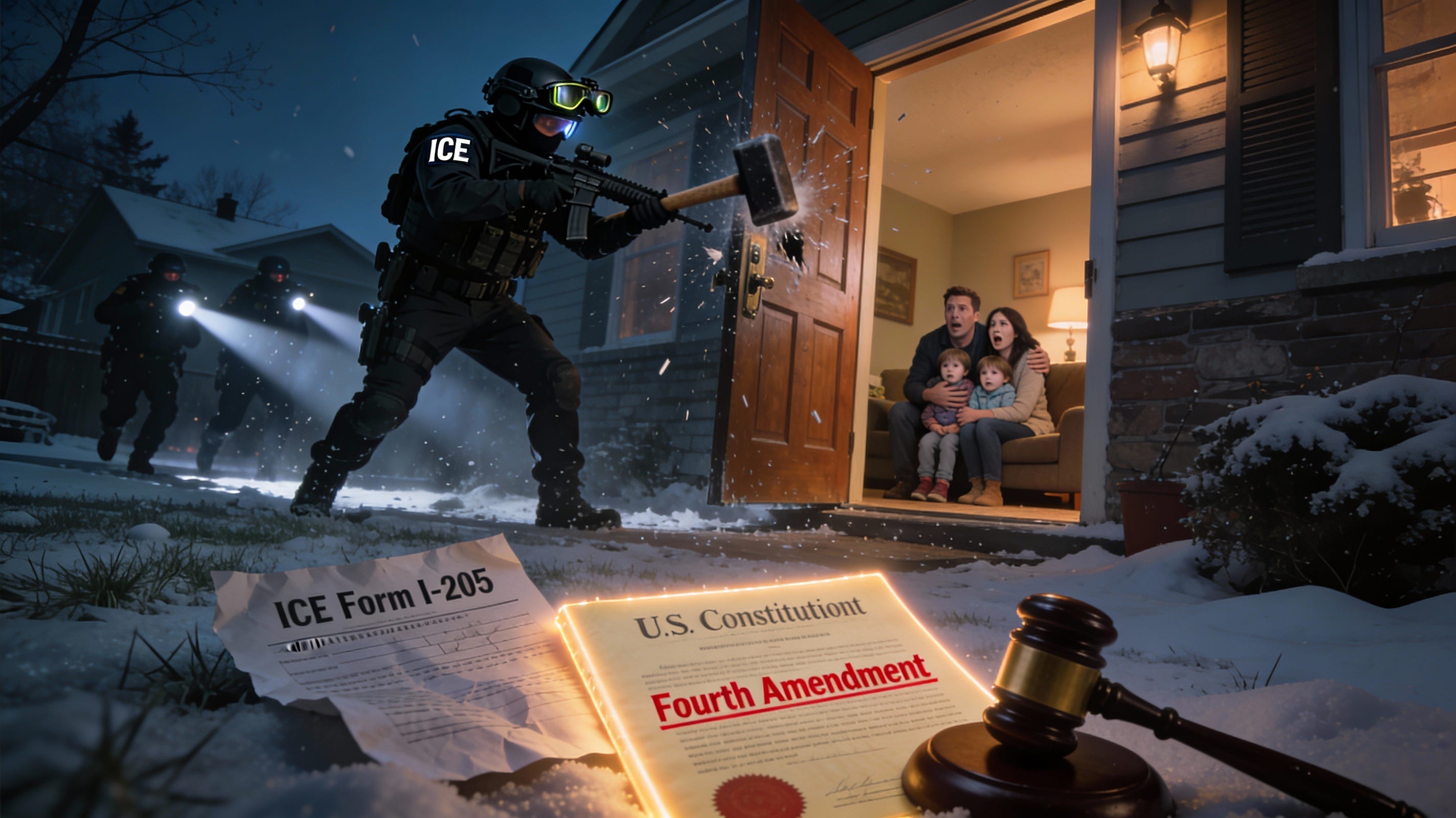
Imagine waking up to the sound of your front door being rammed in at six o’clock in the morning — armed agents in tactical gear pouring into your living room, rifles raised, shouting commands, kids screaming.
And when you ask for a warrant signed by a judge, they wave a piece of paper their own agency printed and tell you that’s good enough.
This is not a hypothetical scenario.
An internal memo from Immigration and Customs Enforcement (ICE), quietly circulated to select officials and revealed by whistleblowers this month, instructs agents that they may forcibly enter private residences based solely on a civil “administrative warrant” — Form I‑205 — without the consent of the occupants and without a warrant from a neutral magistrate.
In other words, like Captain Barbossa, ICE decided the Fourth Amendment is “more what you’d call ‘guidelines’ than actual rules.” A couple of federal judges just reminded them it is not.
A Secret Memo That Reads Like a Police‑State Wish List
The Associated Press first exposed the memo, signed by Acting ICE Director Todd Lyons in May 2025, after whistleblowers handed it to Congress and the watchdog group Whistleblower Aid.
The document instructs agents that they may enter “without consent, including by a necessary and reasonable level of force,” provided they have an administrative warrant for a person with a final order of removal.
That’s a huge departure from ICE’s own prior training materials, which acknowledged the basic rule every first‑year law student learns: entering a home without consent or a judicial warrant “typically violates the Fourth Amendment,” no matter how strong your probable cause.
Constitutional scholars aren’t being coy about what this means. One Ohio State law professor called the policy “essentially authorizing a violation of fundamental rights we’ve had as Americans since the Bill of Rights was passed,” pointing out that it flies in the face of “literally 250 years of case law” on search and seizure.
Former federal judges have been just as blunt: administrative paperwork signed by an agency lawyer is not a substitute for a warrant from a neutral, detached magistrate.
ICE’s lawyers, however, apparently decided they could just rewrite the Fourth Amendment by memo.
Minnesota Becomes a Test Bed for Warrantless Home Raids
The memo didn’t stay theoretical for long. In Minneapolis and St. Paul, journalists have already documented agents using battering rams to smash through doors and haul families out into freezing weather — sometimes on the basis of nothing more than an internal ICE form.
One of those raids, on a Liberian immigrant identified in court as Garrison G., led to a January 17 order from U.S. District Judge Jeffrey Bryan, who ruled that ICE violated both federal regulations and the Fourth Amendment when agents forced their way into the home with only an administrative warrant.
In another case, a different judge ordered DHS and ICE to release six Venezuelan family members detained during a highly publicized St. Paul raid after the government missed a deadline to produce a valid warrant.
Minnesota officials are fed up.
Attorney General Keith Ellison and the cities of Minneapolis and St. Paul have sued the Trump administration over “Operation Metro Surge,” arguing that the deployment of thousands of paramilitary‑style agents to the state is unconstitutional retaliation for Minnesota’s politics and an assault on state sovereignty.
Their complaint alleges violations of the First Amendment (targeting based on political viewpoint), the Tenth Amendment (commandeering state resources and usurping local policing powers), and the Constitution’s guarantee of equal sovereignty among the states.
So let’s recap.
ICE claims it can break into your home on the strength of its own paperwork. Judges in Minnesota are starting to say “no, you can’t.” And civil‑rights lawyers are lining up to ask federal courts to remind the administration that the Bill of Rights still applies north of the Red River.
This Is Exactly the Kind of Abuse the Fourth Amendment Was Written To Prevent
If this whole situation sounds familiar, that’s because American history already gave us a version of this script.
In the years before the Revolution, British officials used “writs of assistance” — open-ended search warrants — to barge into colonists’ homes and businesses in search of untaxed goods. James Otis famously argued against those writs, warning that if government agents could search wherever they wished without a particularized warrant, every man’s house would cease to be his castle.
The Founders responded by writing the Fourth Amendment. It doesn’t say “no unreasonable searches and seizures… unless an executive‑branch lawyer thinks it’s fine this time.” It requires probable cause, supported by oath or affirmation, and a particular description of the place to be searched and the persons or things to be seized.
Administrative warrants signed by ICE supervisors do not meet that standard. They are civil documents issued by the same agency that wants to do the searching — not by a neutral judge. That’s why ICE’s own manuals used to teach agents that, absent consent or narrow exceptions (like hot pursuit), you wait until your target steps outside. You don’t kick the door in.
ICE’s new memo tries to erase that line. If they can get away with it in Minnesota, why wouldn’t other federal agencies expand it nationwide?
What a Principled, Limited‑Government Approach Would Look Like
So what should be happening instead?
First, Congress must make it explicit — in statute — that administrative warrants are not enough to enter a home. That’s already what the Constitution and Supreme Court precedent say, but clearly ICE’s lawyers need remedial education.
Second, legislators at both the federal and state levels should do what Minnesota is trying to do: sue when the federal government uses police powers to punish a state for its politics, and refuse to cooperate with operations that flout the Constitution.
Third, Congress should finally pass something like the Qualified Immunity Abolition Act so that federal agents who ignore the Fourth Amendment cannot hide behind judge‑invented shields when they violate people’s rights. If a federal law enforcement agency knows it can be sued personally for kicking in a door without a real warrant, behavior will change.
This should not be a partisan issue. Even those who support Trump’s immigration policies should be able to acknowledge when federal agencies overstep their boundaries.
The government we live under today is far more bloated and intrusive than the one that pushed the colonists to revolt. Its officials will always find ways to push that constitutional line — especially when they know at least half the country approves of it.


ICE HAS A CONSTITUTIONAL RIGHT TO SEARCH FOR AND REMOVE ILLEGAL ALIENS NO MATTER WHERE OR WHO IS HIDING THEM
This administration has been planning this. They want a one federal police government.